Wednesday, March 16, 2011

Celebrating the Irish

In honor of St. Patrick's Day I thought I would do a short book review.  Well, more of a book recommendation and brief summary.
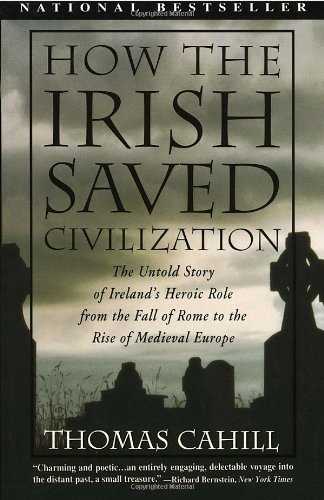
Last summer I read How the Irish Save Civilization: The Untold Story of Ireland's Heroic Role from the Fall of Rome to the Rise of Medieval Europe by Thomas Cahill and it was amazing.  It is one of the best history books I've read.  Cahill has a meter and tone that make the story flow in a way that keeps your nose in the book.
The story goes like this:
St. Patrick, a former slave of the Irish, returns to Ireland and preaches the gospel to the Irish.  The Irish being the kind of people who take something and hold on tight, become a united people and through the efforts of the rising Irish church become educated. The newly educated island dwellers begin grabbing up and hoarding any books they can get their hands on.  This is all happening before the Roman world collapses and falls into the Dark Ages.
When the pillaging vikings come calling the Irish hide their treasures in the ground.  But not only do they hide their tangible wealth they begin to hide their intellectual wealth as well.  Countless volumes from the Roman world and before were saved only in Ireland.  Without the Irish we might not have even heard of Homer, or the Greeks, or anything else before the Renaissance.
This book is a great read for anyone who likes a story.  Pick it up and get ready for a trip back in time.

Tuesday, March 15, 2011

Buying Members

Consumerism (and gnosticism) might be the most poisonous things to ever seep into the church.  It has changed how we see the church.  It has changed how we worship and what is in our services and gatherings.  It has changed why we go to the churches that we do.  Maybe most hideously, it has changed the way we the church interact with the communities we are settled in.
Consumerism is all about buying, purchasing, and getting in greater and greater amounts. While the desire to build wealth and accumulate possessions is not new, this is relatively new to church.  There has been a shift from community to individual and with it the principles of buying power have come to churches.
Churches now are buying the people who fill their pews.  Not with money but with music, performances, and programs.  Since consumerism has come to the church people are jumping from one church to another with reckless abandon.  Churches are experiencing growth as result of church moving rather than growth from new people joining the body.
Christianity Today interviewed T. David Gordon about his new book.  He says that the constant hearing of pop music in our day to day lives has ruined us for hymns and he laments the lose.  In his book he talks about the shift from traditional church music to pop-like music. He attributes it in large part to the seeker sensitive movement.  From where I sit the seeker sensitive movement is the perfect example of consumerism.
We need to move from the over programed approach to a simple disciple building model.  How this fleshes out in each church community will be different, but the basics will be the same.  Firm foundation in Bible teaching, community gatherings to worship, serving the local community (and the world) in tangible ways, and evangelism (likely through serving the community in tangible ways).

Monday, March 14, 2011

Dan and living in a foreign land

One of my most common struggles is answering how I should live in this foreign land.  The Bible tells us that Christians are only journeying through and that we are traveling to somewhere greater.  But how do we act and what do we do on the way?
Much of Daniel’s life was spent away from his home.  As a boy he was a member of the royal family and lived in Jerusalem but in 605 B.C. he was taken off to Babylon.  Even his name was taken from him.  You see, he is like us.  Just like we live in a foreign land, Daniel lived in Babylon.  Maybe more than any other person in the Bible Daniel serves as an example to us of how we should live in exile.
Scripture tells us that Daniel was very smart and talented.  For this reason he was chosen to serve in the court of king.  The king gave Daniel many resources and Daniel learned all the things he would need to know about the foreign empire that had captured him.  He learned all the customs and history, lore and ritual but still maintained a distinctive difference between himself and the Babylonians.
Daniel led a life that reflected his home.  He lived within the confines of the culture around him but he was unchanged by them.  Instead of defiling himself, he chose to be a living example even when it meant that he might die.
He did not act on his own strength but had Divine help.  His ability to remain faithful to Yahweh was not an act of person strength of will but an exercise of trust.  Daniel trusted Yahweh to take care of him and meet his needs.
The challenge for us now is live like Daniel did in Babylon.  We are to be an example to the world we live in, and trust in the Yahweh to meet our needs.

Wednesday, March 9, 2011

Wednesday Madness

Today is the first day of Lent, a season of fasting and remembering.  Ash Wednesday is not a feast or celebration but a day when the body of Christ collectively acknowledges our sin and repents.  We then begin the 40 day fast until Palm Sunday.  Why participate in Lent?  One idea is to be unnecessarily devoted.  I will suggest 3 more:
  1. To identify with the 40 day fast of Jesus Christ before His Temptation
  2. To remind us of our sin, and repent
  3. To prepare our hearts and minds for Holy Week and Resurrection Sunday (a.k.a. Easter)
Ash Wednesday is named because of the tradition of pouring ash over your head as a sign of grief. This was often accompanied with wearing of sackcloth.  You see it over and over again in the Old Testament.  Today the it is much more common to have the sign of the cross drawn on your forehead in ash.  No matter the particular practice it is an outward sign of a humbled and penitent spirit. 
If you haven’t begun to participate in the Lenten fast it is not too late.  Choose something to part with for the 40 days.  I recommend not choosing something for health reasons or an action that you already know to be wrong, these defeat the purpose.  I have chosen to give up candy, not because it is bad for me but because I love it and it will be painful to go without for 40 days.

Just for fun here is a prayer from the Book of Common Prayer for Ash Wednesday:
Almighty and everlasting God, you hate nothing you have made and forgive the sins of all who are penitent: Create and make in us new and contrite hearts, that we, worthily lamenting our sins and acknowledging our wretchedness, may obtain of you, the God of all mercy, perfect remission and forgiveness; through Jesus Christ our Lord, who lives and reigns with you and the Holy Spirit, one God, for ever and ever. Amen.

Thursday, March 3, 2011

Trust

Trust is a funny thing.  The Bible tells us that trust is a key component of love.  Jesus also tells us to be shrewd and wise.  It is a balance that I am pretty sure that I fail to maintain often.

One of the reasons that many youth end up in trouble is because their parents have trusted them too much and don't check up on their children's comings and goings. Many children end up parenting themselves and sometimes their siblings.  The brothers of the Taize community attribute the fact that they welcome 100,000 youth every year because they trust them.  How do we hold these truths in tension?  When do we trust and when do we learn from experience and not trust?