Christians are being killed by their own countrymen in Egypt. Not altogether a surprise in the Muslim controlled Middle East (even though Egypt is in Africa). The military denies killing the peaceful Christian protesters or at least doing it on purpose.
When it comes to persecution of Christians I always have mixed feelings. I mourn their deaths but celebrate their faith. I pray for peace but wonder if a little hardship wouldn't do the Western Christian Church some good. Jesus warns us that persecution is going to be part of our lives, we are blessed when we are persecuted, and tells us that we are to bless the ones who persecute us. The author of Hebrews praised the people who joyfully accepted persecution.
The greatest movements in Church (numbers and discipleship) have included being persecuted. The early church and now the church in China.
I pray for peace in lives that are living under persecution, but I also pray that the West will have the faith to withstand the trials that may come upon us.
Thursday, October 13, 2011

Monday, October 10, 2011
The Great Recovery
I am a huge fan of Dave Ramsey. The guy knows his money and mine. He has guided me to a more biblical understanding and use of my money. Like so many of us he knows that the government isn't the answer to the financial problems that our country is facing. The Great Recovery is a grass roots movement to get our country's financial house in order one house at the time.
What are you doing to help the nation or you own economic situation?
What are you doing to help the nation or you own economic situation?
Friday, October 7, 2011
The Wrong Boat To Be In
I have a tendency to neglect Mark's Gospel. I don't really know why. Maybe it's because it's the shortest. But I have been reading through it slowly over the last weeks. Toward the end of chapter 6 there is a verse that has been on mind a lot lately. I just can't let it go.
A lot is going on in chapter 6. Jesus returns to His home town, He sends out the twelve without many material comforts, John the Baptist is murdered and that's just the first 29 verses. I want to pick up in verse 30. Here Jesus receives the apostles back and they jump in a boat to go find a quiet place to rest. But a bunch of people crash their plans for rest and Jesus, being the awesome Lord that He is, gives the crowd what they came for and starts teaching. But it was getting late and the people were hungry, so Jesus uses His divine power to take five loaves of bread and two fish to feed five thousand men and everyone else that had showed up. Then there is leftovers.
Right after that Jesus sends His disciples back to the boat with orders to go ahead of Him. He'll catch up later. He takes His leave and finds a place to pray to the Father alone. By the time He is done the boat is in the middle of the lake with the wind working against them. They had to row instead of sail. It has not been their day.
Jesus, being God and man, just walks out onto the lake and begins to pass the disciples in the boat. They of course freak out and are terrified, like anyone in their right mind would be. He puts their minds at ease and announces “Take courage! It is I. Don't be afraid.” Jesus climbs in the boat and immediately the wind dies down and the disciples are shocked into amazement.
Then there is the little verse 52. It says “for they had not understood about the loaves: their hearts were hardened.”
At this point all I can think of is Pharaoh and his hard heart. Look what happened there. His kingdom is ravaged by plagues and then he loses a whole bunch of slaves. The disciples must be in the same boat with Pharaoh. Not a good boat to be in. I think that I am in that boat sometimes. I just don't understand what God is showing me and my heart hardens. My new prayer is that God will work in my heart to soften it and that I will understand His messages to me.
Even on the worst days we are still expected to understand what God is doing when He reveals Himself to us. Look at the disciples' day. They get back from a mission trip expecting to debrief with Jesus (who sent them in the first place), and they end up in a large crowd, seeing a miracle, get sent ahead in bad weather, so instead of sailing they have to row. Then Jesus shows up walking on water. And what do you know, they don't get it that Jesus is the Son of God, God Himself.
Saturday, October 1, 2011
A blog I like
I am subscribed to 22 blogs. But my favorite is artofmanliness. It is a treasure trove of new ideas, skills, project, inspirations, just interesting information. So this is just a promo because I like there stuff and I'm trying to post more.
Wednesday, April 13, 2011
Fatherhood Update 1
It has been a long time since my last post. I have been busy. I am now the father of 5 boys ages 12 to 19 and, man, do they keep me busy. Stephanie and I have been working as house parents for boys who need more supervision than foster care can provide for about 8 months now. We have seen a lot. Our future unborns aren't going to be able to hide much from us. We daily deal with depression, ADHD, violence, unruly and obstinate behavior, inappropriate internet use, bullying, and these are the things I can list. We get sworn at, threatened, and lied to constantly.
We love this job.
We love this job.
Wednesday, March 16, 2011
Celebrating the Irish
In honor of St. Patrick's Day I thought I would do a short book review. Well, more of a book recommendation and brief summary.
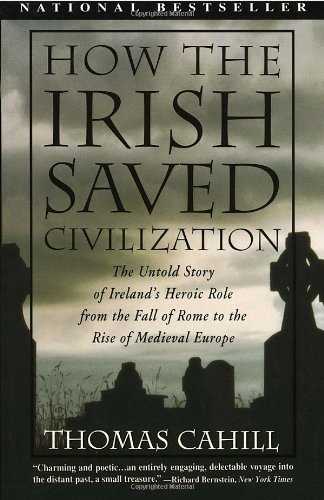 Last summer I read How the Irish Save Civilization: The Untold Story of Ireland's Heroic Role from the Fall of Rome to the Rise of Medieval Europe by Thomas Cahill and it was amazing. It is one of the best history books I've read. Cahill has a meter and tone that make the story flow in a way that keeps your nose in the book.
The story goes like this:
St. Patrick, a former slave of the Irish, returns to Ireland and preaches the gospel to the Irish. The Irish being the kind of people who take something and hold on tight, become a united people and through the efforts of the rising Irish church become educated. The newly educated island dwellers begin grabbing up and hoarding any books they can get their hands on. This is all happening before the Roman world collapses and falls into the Dark Ages.
When the pillaging vikings come calling the Irish hide their treasures in the ground. But not only do they hide their tangible wealth they begin to hide their intellectual wealth as well. Countless volumes from the Roman world and before were saved only in Ireland. Without the Irish we might not have even heard of Homer, or the Greeks, or anything else before the Renaissance.
This book is a great read for anyone who likes a story. Pick it up and get ready for a trip back in time.
The story goes like this:
St. Patrick, a former slave of the Irish, returns to Ireland and preaches the gospel to the Irish. The Irish being the kind of people who take something and hold on tight, become a united people and through the efforts of the rising Irish church become educated. The newly educated island dwellers begin grabbing up and hoarding any books they can get their hands on. This is all happening before the Roman world collapses and falls into the Dark Ages.
When the pillaging vikings come calling the Irish hide their treasures in the ground. But not only do they hide their tangible wealth they begin to hide their intellectual wealth as well. Countless volumes from the Roman world and before were saved only in Ireland. Without the Irish we might not have even heard of Homer, or the Greeks, or anything else before the Renaissance.
This book is a great read for anyone who likes a story. Pick it up and get ready for a trip back in time.
Tuesday, March 15, 2011
Buying Members
Consumerism (and gnosticism) might be the most poisonous things to ever seep into the church. It has changed how we see the church. It has changed how we worship and what is in our services and gatherings. It has changed why we go to the churches that we do. Maybe most hideously, it has changed the way we the church interact with the communities we are settled in.
Consumerism is all about buying, purchasing, and getting in greater and greater amounts. While the desire to build wealth and accumulate possessions is not new, this is relatively new to church. There has been a shift from community to individual and with it the principles of buying power have come to churches.
Churches now are buying the people who fill their pews. Not with money but with music, performances, and programs. Since consumerism has come to the church people are jumping from one church to another with reckless abandon. Churches are experiencing growth as result of church moving rather than growth from new people joining the body.
Christianity Today interviewed T. David Gordon about his new book. He says that the constant hearing of pop music in our day to day lives has ruined us for hymns and he laments the lose. In his book he talks about the shift from traditional church music to pop-like music. He attributes it in large part to the seeker sensitive movement. From where I sit the seeker sensitive movement is the perfect example of consumerism.
We need to move from the over programed approach to a simple disciple building model. How this fleshes out in each church community will be different, but the basics will be the same. Firm foundation in Bible teaching, community gatherings to worship, serving the local community (and the world) in tangible ways, and evangelism (likely through serving the community in tangible ways).
Consumerism is all about buying, purchasing, and getting in greater and greater amounts. While the desire to build wealth and accumulate possessions is not new, this is relatively new to church. There has been a shift from community to individual and with it the principles of buying power have come to churches.
Churches now are buying the people who fill their pews. Not with money but with music, performances, and programs. Since consumerism has come to the church people are jumping from one church to another with reckless abandon. Churches are experiencing growth as result of church moving rather than growth from new people joining the body.
Christianity Today interviewed T. David Gordon about his new book. He says that the constant hearing of pop music in our day to day lives has ruined us for hymns and he laments the lose. In his book he talks about the shift from traditional church music to pop-like music. He attributes it in large part to the seeker sensitive movement. From where I sit the seeker sensitive movement is the perfect example of consumerism.
We need to move from the over programed approach to a simple disciple building model. How this fleshes out in each church community will be different, but the basics will be the same. Firm foundation in Bible teaching, community gatherings to worship, serving the local community (and the world) in tangible ways, and evangelism (likely through serving the community in tangible ways).
Monday, March 14, 2011
Dan and living in a foreign land
One of my most common struggles is answering how I should live in this foreign land. The Bible tells us that Christians are only journeying through and that we are traveling to somewhere greater. But how do we act and what do we do on the way?
Much of Daniel’s life was spent away from his home. As a boy he was a member of the royal family and lived in Jerusalem but in 605 B.C. he was taken off to Babylon. Even his name was taken from him. You see, he is like us. Just like we live in a foreign land, Daniel lived in Babylon. Maybe more than any other person in the Bible Daniel serves as an example to us of how we should live in exile.
Scripture tells us that Daniel was very smart and talented. For this reason he was chosen to serve in the court of king. The king gave Daniel many resources and Daniel learned all the things he would need to know about the foreign empire that had captured him. He learned all the customs and history, lore and ritual but still maintained a distinctive difference between himself and the Babylonians.
Daniel led a life that reflected his home. He lived within the confines of the culture around him but he was unchanged by them. Instead of defiling himself, he chose to be a living example even when it meant that he might die.
He did not act on his own strength but had Divine help. His ability to remain faithful to Yahweh was not an act of person strength of will but an exercise of trust. Daniel trusted Yahweh to take care of him and meet his needs.
The challenge for us now is live like Daniel did in Babylon. We are to be an example to the world we live in, and trust in the Yahweh to meet our needs.
Wednesday, March 9, 2011
Wednesday Madness
Today is the first day of Lent, a season of fasting and remembering. Ash Wednesday is not a feast or celebration but a day when the body of Christ collectively acknowledges our sin and repents. We then begin the 40 day fast until Palm Sunday. Why participate in Lent? One idea is to be unnecessarily devoted. I will suggest 3 more:
- To identify with the 40 day fast of Jesus Christ before His Temptation
- To remind us of our sin, and repent
- To prepare our hearts and minds for Holy Week and Resurrection Sunday (a.k.a. Easter)
Ash Wednesday is named because of the tradition of pouring ash over your head as a sign of grief. This was often accompanied with wearing of sackcloth. You see it over and over again in the Old Testament. Today the it is much more common to have the sign of the cross drawn on your forehead in ash. No matter the particular practice it is an outward sign of a humbled and penitent spirit.
If you haven’t begun to participate in the Lenten fast it is not too late. Choose something to part with for the 40 days. I recommend not choosing something for health reasons or an action that you already know to be wrong, these defeat the purpose. I have chosen to give up candy, not because it is bad for me but because I love it and it will be painful to go without for 40 days.
Just for fun here is a prayer from the Book of Common Prayer for Ash Wednesday:
Almighty and everlasting God, you hate nothing you have made and forgive the sins of all who are penitent: Create and make in us new and contrite hearts, that we, worthily lamenting our sins and acknowledging our wretchedness, may obtain of you, the God of all mercy, perfect remission and forgiveness; through Jesus Christ our Lord, who lives and reigns with you and the Holy Spirit, one God, for ever and ever. Amen.
Thursday, March 3, 2011
Trust
Trust is a funny thing. The Bible tells us that trust is a key component of love. Jesus also tells us to be shrewd and wise. It is a balance that I am pretty sure that I fail to maintain often.
One of the reasons that many youth end up in trouble is because their parents have trusted them too much and don't check up on their children's comings and goings. Many children end up parenting themselves and sometimes their siblings. The brothers of the Taize community attribute the fact that they welcome 100,000 youth every year because they trust them. How do we hold these truths in tension? When do we trust and when do we learn from experience and not trust?
One of the reasons that many youth end up in trouble is because their parents have trusted them too much and don't check up on their children's comings and goings. Many children end up parenting themselves and sometimes their siblings. The brothers of the Taize community attribute the fact that they welcome 100,000 youth every year because they trust them. How do we hold these truths in tension? When do we trust and when do we learn from experience and not trust?
Thursday, February 3, 2011
Long Quote
A quote from Life Together by Dietrich
Often the difference between an experienced Christian and the novice becomes clearly apparent. It may be taken as a rule for the right reading of the Scriptures that the reader should never identify himself with the person who is speaking in the Bible. It is not I that am angered, but God; it is not I giving consolation, but God; it is not I admonishing, but God admonishing in the Scriptures. I shall be able of course to express the fact that it is God who is angered who is consoling and admonishing, not by indifferent monotony, but only with inmost concern and rapport, as one who knows that he himself is being addressed. It will make all difference between right and wrong reading of Scriptures if I do not identify myself with God but quite simply serve Him. Otherwise I will become rhetorical, emotional, sentimental, coercive and imperative; that is, I will be directing the listeners' attention to myself instead of the Word. But this is to commit the worst of sins in presenting the Scriptures.
I thought this better than anything I have to say today.
Often the difference between an experienced Christian and the novice becomes clearly apparent. It may be taken as a rule for the right reading of the Scriptures that the reader should never identify himself with the person who is speaking in the Bible. It is not I that am angered, but God; it is not I giving consolation, but God; it is not I admonishing, but God admonishing in the Scriptures. I shall be able of course to express the fact that it is God who is angered who is consoling and admonishing, not by indifferent monotony, but only with inmost concern and rapport, as one who knows that he himself is being addressed. It will make all difference between right and wrong reading of Scriptures if I do not identify myself with God but quite simply serve Him. Otherwise I will become rhetorical, emotional, sentimental, coercive and imperative; that is, I will be directing the listeners' attention to myself instead of the Word. But this is to commit the worst of sins in presenting the Scriptures.
I thought this better than anything I have to say today.
Wednesday, January 26, 2011
I want to be a monk
I found a new fascination in the monastic tradition. I've probably mentioned that here before. I find the "new monastic" movement really attractive. Maybe it is the refocus on the ancient traditions and disciplines of the historical Church. I could find myself legalistic in that way if I was more committed and disciplined.
More than anything I love their idea of community, and that usually there is less focus on the weekly gathering and more on daily living. The communities that I have heard about are attracting people not because of their daycare and music, but because people are seeing Christ. Christ is real and living in these communities.
Not everyone is called to be a monk, in either the old or new ways. But the principles of living together, and loving one another and then our neighbors could revolutionize the institutional churches that pepper the country. After all, Jesus (the one who is supposed to be leading this whole thing) once said something to the effect that we Christians would be known by our love for each other. The question is how do we move toward living like that? How do we in the institutional churches create community like the monastics without starting our own monastic communities? I don't think that abandoning what we have is the solution, but maybe we need a new reformation. A reformation that would bring back together the fractured church and end denominationalism. Anyone with me?
More than anything I love their idea of community, and that usually there is less focus on the weekly gathering and more on daily living. The communities that I have heard about are attracting people not because of their daycare and music, but because people are seeing Christ. Christ is real and living in these communities.
Not everyone is called to be a monk, in either the old or new ways. But the principles of living together, and loving one another and then our neighbors could revolutionize the institutional churches that pepper the country. After all, Jesus (the one who is supposed to be leading this whole thing) once said something to the effect that we Christians would be known by our love for each other. The question is how do we move toward living like that? How do we in the institutional churches create community like the monastics without starting our own monastic communities? I don't think that abandoning what we have is the solution, but maybe we need a new reformation. A reformation that would bring back together the fractured church and end denominationalism. Anyone with me?
Monday, January 24, 2011
Resolved
While most of the world is giving up, I am finally getting started with my resolutions. I have two. I want to keep up with this blog better, and try posting once a week. And I want to do a better job keeping in touch. I started today by writing a letter. I want to try to correspond with 5 or 6 people who I just don't talk to often enough.
So keep checking in here for an updated blog...More posts coming soon.
P.S. Any grammar or spelling errors are Stephanie's fault, she isn't here to fix my mistakes.
So keep checking in here for an updated blog...More posts coming soon.
P.S. Any grammar or spelling errors are Stephanie's fault, she isn't here to fix my mistakes.
Subscribe to:
Posts (Atom)